
Quick answer: AI UGC ads are cheaper and faster, real creators are more trusted. Industry figures put an AI UGC video at roughly $5 to $30 and a human creator video at $150 to $500. For a small business the smart move is usually both: use AI to find the hook that works, then decide whether that winner needs a real face. One rule matters more than the price, especially in the US. An AI avatar can show your product. It cannot pretend to be a customer.
Below is what AI UGC ads are, what each route costs, which one performs better and when, the US rules on fake testimonials and AI labels, and a simple test plan that does not waste a month of budget.
What is an AI UGC ad?
UGC means user generated content: the handheld, talk to camera style of video that looks like a person filmed it on their phone. An AI UGC ad copies that style without a creator. The person on screen is an AI avatar, the voice is synthetic, and the script is written for the ad.
The style works because it does not look like an ad. People stop scrolling for a face and a sentence that sounds real, not for a logo. That same trick is why the format has rules, and they are stricter in the US than most people think.
AI UGC vs real creators: what does each cost?
Most published numbers come from companies that sell one of the two, so read them as ranges, not quotes.
| Route | Reported cost per video | Turnaround | Best for |
|---|---|---|---|
| AI UGC tool, do it yourself | About $5 to $30 (Segwise) | Hours | Testing many hooks quickly |
| Entry level UGC creator | About $50 to $150 (Billo) | Days to weeks | Simple reviews and unboxings |
| Typical UGC creator | About $150 to $300 (Billo) | Days to weeks | Demonstrations and honest reactions |
| Experienced creator | About $300 to $500 and up (Billo) | Weeks | Scaling a proven winner |
The tool price leaves out the part that decides results: the script, the hook, the edit and the judgement about what to say. A cheap clip that says nothing is still expensive, because the ad budget behind it is wasted.

A real creator still wins when the product has to be touched to be believed.
Which performs better, AI UGC or real creators?
It depends on what you sell. We make AI UGC for clients, and we still tell some of them to hire a real creator, because both sides of this debate oversell. Segwise describes a Meta ads test in skincare, a category where human creators still held a measurable edge, because applying a product to real skin and reacting on camera reads as more believable. The same report notes that a hook first found with AI did better once it ran behind a real face.
Audience trust is the other half. IAB research reported in early 2026 found a wide gap: 82% of advertising executives believed consumers feel positive about AI ads, while only 45% of consumers actually did. So AI ads can work, but nobody watches one because it is AI. It has to earn the first two seconds like any other ad.
In practice AI UGC tends to do well in a few situations:
- The message is simple. One product, one benefit, one offer.
- You need many versions. Three openings for the same offer is a cheap test with AI and an expensive one with creators.
- Nobody wants to be on camera. Many owners would rather never film themselves, and AI removes that blocker.
- The product is easy to show. Gadgets, apps, home items, simple services.
Can an AI avatar give a testimonial in the US?
No, not as a customer. In August 2024 the Federal Trade Commission finalized a rule banning fake reviews and testimonials, and it has been in force since October 2024. It covers testimonials that misrepresent that they come from someone who does not exist, the FTC’s own example being AI generated fake reviews, or from someone with no real experience of the product. The FTC can seek civil penalties against businesses that knowingly break it.
For an AI UGC ad this draws a clear line:
- Allowed in principle: an avatar presenting the product, explaining how it works, or showing a use case.
- Not allowed: an avatar saying “I used this for three weeks and my skin cleared up” when no such person or experience exists.
- The safe habit: real results come from real customers, with their permission, and the avatar never speaks as one of them.
This is general information, not legal advice. If your claims are about health, money or results, have them checked before the ad runs.

Write the script so the avatar presents the product and never claims to be a customer.
Do you have to label AI UGC ads?
Increasingly, yes. Meta shows an “AI info” label and says it adds information to ads it detects were made with third party AI tools. Marketing publications such as Common Thread Co and 1ClickReport describe Meta extending disclosure to commercial ads in 2026 and placing the label next to “Sponsored” when an ad shows a photorealistic AI person. TikTok’s AI generated content label is required on videos that use AI to create a realistic depiction of a person.
Platform rules are changing quickly, so the safe habit is simple. Turn on each platform’s AI disclosure setting when the person, voice or scene is generated, and check the current ad policy before every launch. A labeled ad that runs beats an unlabeled one that gets rejected halfway through a test.
A simple test plan for a small business
- Pick one offer. One product or service, one price, one audience. Changing several things at once teaches you nothing.
- Write three different hooks. A scene, a surprising fact, and a common objection answered in the first two seconds. The opening should feel like content, not a command to buy.
- Make all three with AI. Same offer, same length, only the opening changes.
- Run them side by side with a small, equal budget. Watch how many people get past the first seconds and how many reply or click.
- Keep the winning hook. If the product needs trust or a physical demonstration, remake the winner with a real creator or a real customer. If not, make more AI versions of it.
- Fix the page the click lands on. The first line of the page should repeat the promise of the ad, or the test measures your website instead of your video.
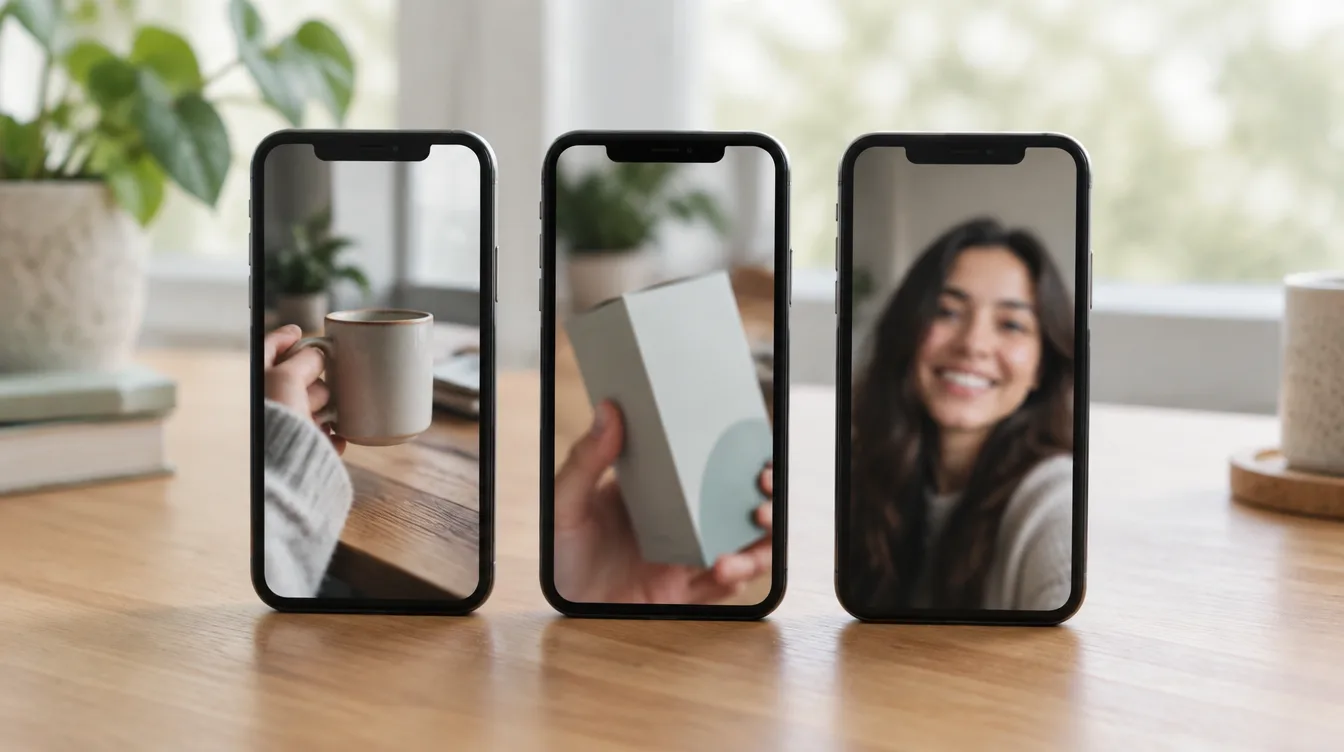
Three openings for the same offer is enough to see a difference.
Where small businesses waste money on AI UGC
Letting the avatar play a customer. It breaks the FTC rule in the US and the trust of anyone who notices.
Hiding that it is AI. Rejected ads and lost trust cost more than a small label.
Judging the channel on one video. One flop tells you about one idea, not about AI or about video.
Paying a creator before you know the hook. A $300 video built on an untested opening is a $300 guess.
Your checklist before you run an AI UGC ad
- You know what the test has to prove, in one sentence
- There are at least three different hooks for the same offer
- No avatar claims personal results or speaks as a customer
- Every claim in the script is true and you could prove it
- The AI disclosure setting is switched on where the platform asks for it
- The landing page repeats the ad’s promise in its first line
- You know which number decides the winner before you start
Questions people ask
What is AI UGC?
Video ads in the handheld, talk to camera style of user generated content, made with an AI avatar and voice instead of a real creator.
Is AI UGC cheaper than hiring creators?
Per video, usually yes. Reported tool costs are about $5 to $30 a video, against $150 to $500 for most human creators. The script and the testing still cost time or money either way.
Do AI UGC ads actually convert?
They can, for simple offers and for testing hooks. For products that depend on trust or a physical demonstration, real creators still tend to do better.
Is it legal to use AI avatars in ads in the US?
Using an avatar to present a product is common. Presenting an avatar as a real customer with a real experience is a fake testimonial under the FTC rule. Check claims with a professional when in doubt.
Do I have to label AI generated ads?
Meta and TikTok both label AI generated content and ask advertisers to disclose realistic AI people. Rules change often, so check each platform’s policy before launch.
Do I need to appear on camera?
No. That is one of the main reasons small businesses choose AI UGC. You send the brief and approve the scripts.
Where to start
Write down what you sell, who usually buys it and the one question the first test should answer. Then write three openings for the same offer and test them before you spend on anything bigger.
If you would like the first test made for you, the video ads and UGC content page explains how we make a batch, and you approve every script before anything is produced. Prices are public on the pricing page: one clip is €90, and a first batch of three different hooks for the same offer is €237. If your product needs a real person on camera, we will tell you. For more on what these ads cost, read AI video ads for small business: what they cost and when they work, and if your ads already get views but no enquiries, see the 6 places it breaks. Or simply send us a message.
Sources: Segwise, AI UGC vs human UGC for Meta ads; Billo, what UGC ads cost; 1ClickReport, Meta ad policy changes 2026; FTC, final rule banning fake reviews and testimonials; Meta, ads transparency and AI labels; Common Thread Co, Meta AI ad labels; Cinerads, AI ad disclosure requirements 2026.