Quick answer: an AI video ad can cost almost nothing to generate and still cost real money to get right. Vendor benchmarks put an AI-assisted ad at about $1 to $5 a cut, a UGC creator video at around $198 and an agency ad at $100 to $500, but those figures leave out the script, the voice, the edits and the testing. The honest question for a small business is not what one clip costs. It is what one tested idea costs, and whether your product suits an AI ad at all.
Below is what AI video ads cost in practice, when they work, when you should film a real person instead, what the platforms expect you to disclose, and a simple way to test one without burning a month of budget.
How much do AI video ads cost for a small business?
It depends who you ask, and the answers are far apart. Sovran’s 2026 production benchmark, quoted by Novo Ads and Enrich Labs, puts typical agency video ads at around $100 to $500, UGC at about $198 on average and AI-assisted ads at $1 to $5 per cut. Imagine Art, a tool vendor, quotes an average of $175 per AI video ad. Novo Ads says a freelancer charges $600 to $1,200 per filming day, and a day usually gives one or two finished clips.
A gap from $1 to $175 is not a disagreement about AI. It is two different things being counted. The low figure is the cost of generating a clip with a tool. The higher one includes a person writing the script, choosing the hook, recording or cloning a voice, editing, adding captions and fixing what comes out wrong. Those are the parts that decide whether anyone stops scrolling.
Generating the clip is the cheap part. Knowing what to say in it is not.
What does it cost compared with the alternatives?
Benchmarks are useful for scale and unreliable for planning, because most of them are published by companies that sell the tool. Use them as a range, not a quote.
| Route | Reported cost | What you still have to do |
|---|---|---|
| AI tool, do it yourself | About $1 to $5 per cut (Sovran, via Novo Ads) | Script, hook, voice, edit, captions, testing |
| UGC creator | About $198 average per video (Sovran) | Find a creator, brief them, wait for the delivery |
| Freelancer | $600 to $1,200 per filming day (Novo Ads) | A filming day usually yields one or two finished clips |
| Agency | About $100 to $500 per ad (Sovran) | Check what is included, and whether revisions cost extra |
For our own work the prices are public. One clip is €90, and a first batch of three different hooks for the same offer is €237 (once per client, so you can judge the work). Monthly plans are €447 for six clips (€74 a clip) and €837 for twelve (€70 a clip), month to month with no lock-in. Our pricing page notes that agencies abroad charge €65 to €131 for a single clip of this kind. You approve every script before anything is made.
When do AI video ads work?
AI is the right tool when you need volume and speed to find out what works. In practice that means a few situations:
- You want to test hooks. The same offer, three different openings. AI makes this cheap enough to actually do
- The message is simple. One offer, one customer, one problem. Explainers and product demos are a good fit
- You have no footage and no time. A shoot day is a week of planning for most small businesses
- You need many versions. Different formats, lengths and captions of the same idea
The point of the first batch is rarely to win. It is to learn which opening a stranger watches past the first two seconds. That is a question about the idea, and it is cheaper to answer with five AI clips than with one filmed one.

Some products should be filmed for real.
When should you film a real person instead?
An AI ad is the wrong choice when the thing you are selling is trust in a real person or a real result. Be straight with yourself about these cases:
- Food and craft. People want to see the actual crust, the actual flour on the hands. A generated loaf is not your loaf
- Before and after results. If the proof is a real outcome, show the real outcome
- Testimonials. Never present an AI actor as a real customer. It is deceptive, it can break platform rules and advertising law, and it is not worth the risk
- A trade where your face is the trust. A plumber, a dentist, a coach. The customer is hiring you, not a clip
- Claims that need care. Health, money and anything regulated. A real person saying a checked claim is safer than a generated one
We say this on our own video ads page too: when your product genuinely needs a real person on camera, we will tell you, rather than selling you the thing we happen to make. A mixed approach also works well, with AI for the hook tests and a real clip once you know which angle wins.
Do you have to say your ad is made with AI?
On some platforms, yes. TikTok’s ad policy asks advertisers to label realistic AI-generated content, and several agencies report that this became mandatory for ads in July 2026. In practice that means a toggle in the ad setup or a visible label. Reports also say that enforcement is patchy and that big brands have skipped labels, so do not treat a gap in enforcement as permission. Meta and Google have their own rules and they change often.
The safe habit is simple. Check the current ad policy of each platform before you launch, label realistic AI people and voices, and keep the label on. It costs nothing and it keeps the account safe, which matters more than any single ad.
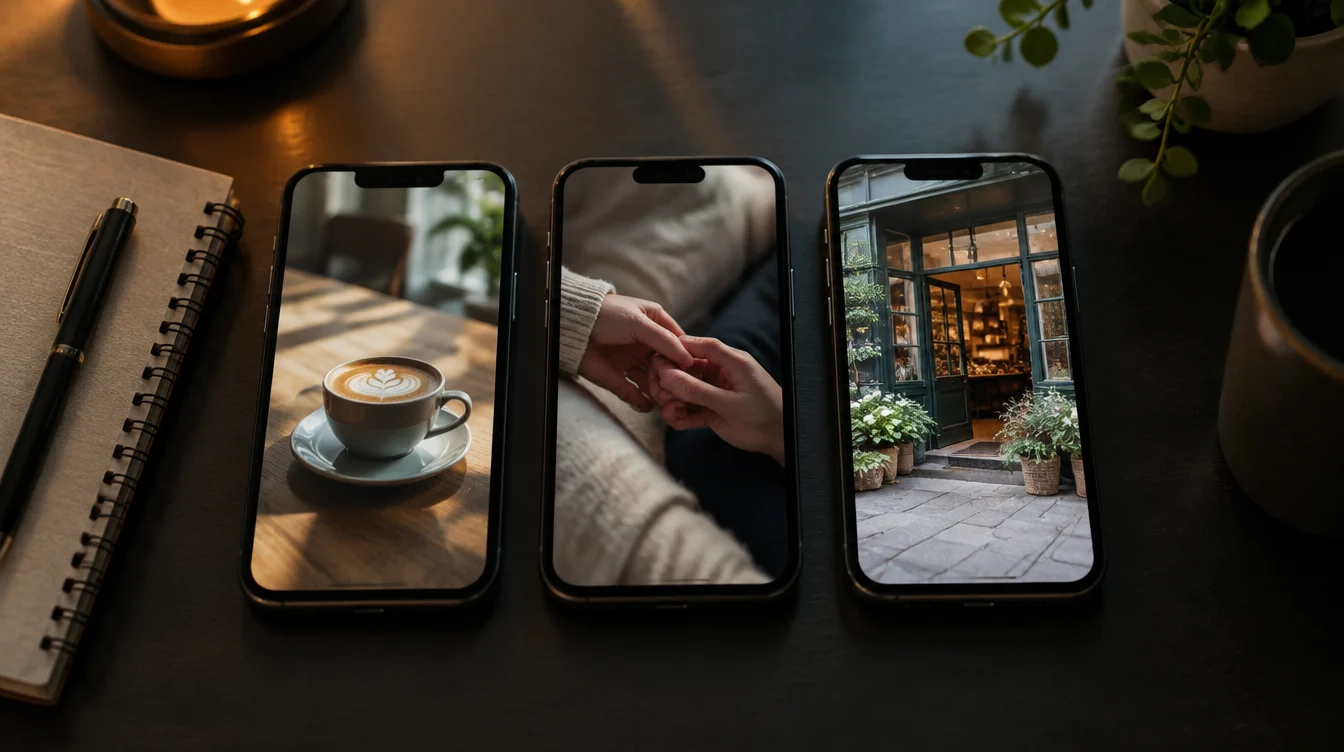
Three hooks for the same offer, tested side by side.
How to test an AI video ad without wasting the budget
- Decide what the test has to prove. Which opening gets watched, or which offer gets replies. One question at a time
- Make three different hooks for the same offer. Same product, same price, three different first two seconds
- Run them the same way. Same audience, same budget, same days. Spend an amount you can afford to lose
- Judge by enquiries, not views. Views alone tell you almost nothing. We cover this in video ads getting views but no enquiries
- Check what happens after the click. A good ad sending people to a slow reply still loses them. See losing leads at the reply, not the ad
- Scale the winner, drop the rest. Then make the next batch around what won
Four mistakes that cost the most
Comparing the cost of one clip. A $3 clip that says nothing costs more than a $90 clip that gets replies.
Making one ad and judging the whole channel. One flop tells you about one idea, not about video.
Hiding that it is AI. It risks the account and the customer’s trust for no gain.
Sending the click to the home page. The page should repeat the ad’s promise in its first line.
Your checklist before you run an AI video ad
- You know what the test has to prove, in one sentence
- There are at least three different hooks for the same offer
- You approved the script before anything was produced
- No AI actor is presented as a real customer
- Realistic AI people and voices carry the platform’s AI label
- The page after the click repeats the promise of the ad
- Someone answers enquiries quickly, in writing
- You decided in advance how long the test runs and what you will do with the result
Questions people ask
How much do AI video ads cost?
Generating a clip with a tool is reported at $1 to $5. A finished ad with script, voice and edits costs more, and published averages run to about $175. Our own prices start at €90 for one clip and €237 for three, with monthly plans at €70 to €74 a clip.
Do AI video ads actually work?
They can, for the right product and the right job. They are strongest for testing hooks and simple offers. They are weaker where the customer needs to see a real person or a real result. No honest provider can promise a result before the first test.
Will my customers know the video is AI?
Some will and some will not, and it matters less than you think once the hook is right. That is no reason to hide it, and platforms may ask you to label realistic AI content.
Is AI better than a UGC creator?
Not better, different. AI is faster and cheaper for testing many ideas. A real creator is better when the viewer needs to believe a real person used the product.
How many ads do I need to test?
Three different hooks for the same offer is a sensible first test. It is enough to see a difference without a big budget.
Do I need to appear on camera?
No. You send the brief and approve the scripts. If you have product shots or footage we can use them, but nothing is required.
Where to start
Write down what you sell, who normally buys it and what you have already tried. Then pick the one thing the first ad has to prove.
If you would like a first test made for you, the video ads and UGC content page explains how a batch is made, the pricing page has every price, and you can send us a message. We reply in writing, usually the same day. If you also need somewhere good to send the traffic, see our websites and online stores. Everything is at giusmastery.com.
Sources: Novo Ads, video ad production cost; Enrich Labs, video marketing agency guide 2026; Imagine Art, how to make video ads; AI Nauten, TikTok AI ad policy; Common Thread Co, TikTok AI ad disclosure rules. Our own prices are taken from our pricing page. Figures from tool vendors are marketing benchmarks, so check current prices and policies before you plan a budget.


