
Someone watches three of your videos, checks your profile, likes what they see, and messages you. Not “how much”, not yet. Just this:
“Do you have a website?”
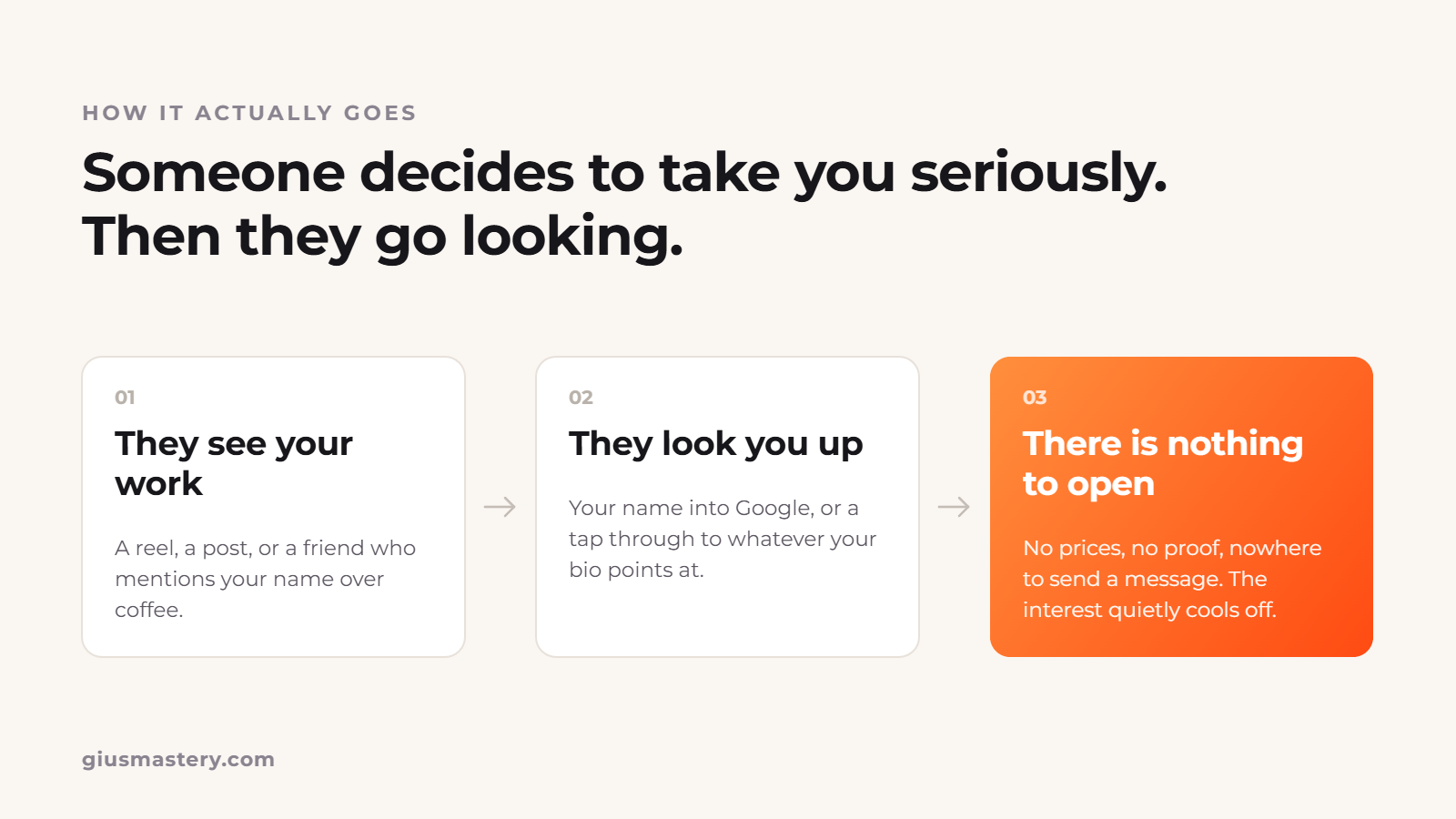
And you send the link in your bio. Which opens a page of buttons. Which opens another profile. And somewhere in there the person stops, because none of it answers the question they actually had, which was whether you are the real thing.
The short version
You do not need a website to get noticed. You already handle that part. You need one for the ten minutes after somebody notices you, when they are quietly deciding whether to trust you with money. That is a different job, and a social profile is not built for it.
Below is what that gap actually looks like, when it matters, and when you can honestly ignore all of this for another six months.
What social does well, and it is not nothing
Let us be fair about it. A good account does things a website simply cannot.
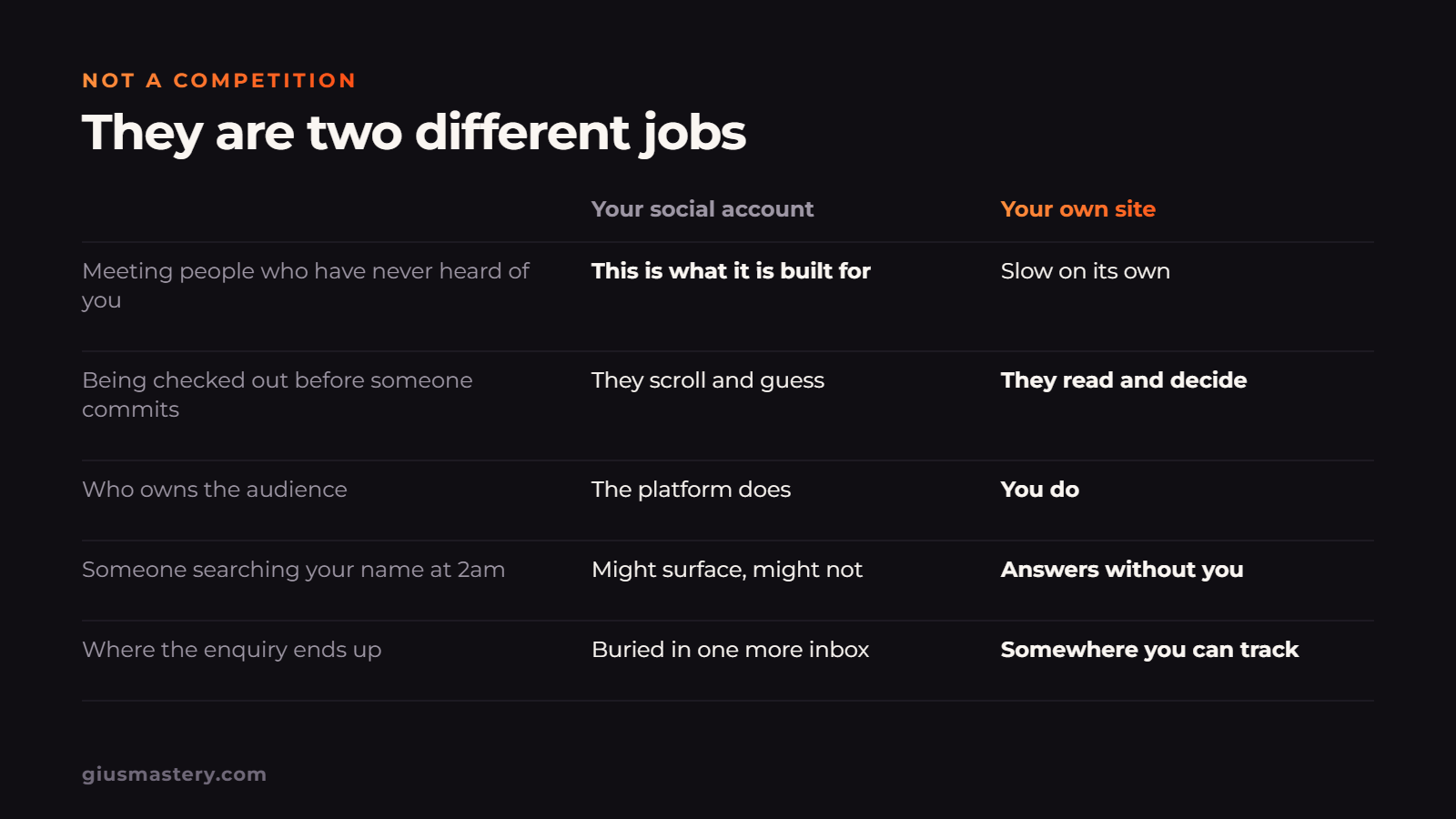
It puts you in front of people who have never heard your name. It lets someone see how you talk, how you work, what you find funny. It builds familiarity over weeks, without anyone having to decide anything. If you are getting enquiries right now with no site at all, that is not luck. That part is working.
So nothing here is an argument to post less. It is an argument about what happens next.
Four places it quietly stops working
1. The link in your bio is a corridor, not a room
A list of buttons is a decision you are asking a stranger to make before they know anything. Most people do not make it. They go back to scrolling, and you never find out they were there.
2. Your best work is buried three months down
The job you are proudest of, the one that would close this person on the spot, is somewhere in a grid, between a reel about the weather and a story that expired. Nobody scrolls that far to check you out. They scroll that far because they already decided.
3. You are renting the audience
Everybody says this and everybody ignores it, so here it is plainly. The account is not yours. The reach is not yours. The followers are a number on someone else’s screen. You are allowed to keep them until you are not.
4. People search for what you do, not for who you are
Nobody types your handle when they do not know your handle. They type the thing they need, and a search engine looks for pages that answer it. A profile is not a page that answers it.

Two different jobs, not two competitors
The framing of “website versus social” is wrong, and it is wrong in a way that costs people money. One brings strangers into the room. The other turns them into customers once they are in it. Take either one away and the other works at half strength.
“But my business is online. I do not have a shop on a street.”
This comes up constantly, and it is worth answering properly, because the advice online is written as if every business has a van and a postcode.
A personal trainer selling programmes to people in four countries has the same problem as a plumber, just wearing different clothes. Somebody hears about you, wants to know what you actually sell, at what price, with what proof, and whether a real person answers. A coach, a freelance designer, a consultant, a shop that lives on marketplaces, a studio that sells one course: all of them hit the same wall at the same moment.
If anything the online-only business needs it more. You have no shopfront, no van with a phone number on the side, no handshake. The site is the only thing standing in for all of that.
When you can honestly skip it
There are real cases where the answer is not yet, and pretending otherwise would be selling you something.
- You are testing an idea you might drop in two months. Do not build anything. Find out if people want it first.
- You sell entirely inside one platform, the platform handles payment, and nobody ever asks you anything outside it.
- You are already at capacity and turning work away. A site would bring you enquiries you cannot serve.
If you are in one of those three, close this tab with a clear conscience. If you are not, the rest is worth five minutes.
It is smaller than you think
The reason most people put this off is that they picture a project. Weeks of decisions, a brief, a logo argument, a bill with a comma in it.
In practice, the thing that closes business is five pages. What you do. Your actual work, with real photos. Who you are, so they can see a face. What it costs, or at least how pricing works. And a form that reaches you in seconds rather than a contact page that goes into a void.
That is it. You can add the blog, the extra service pages and the booking system later, once something is actually running. If you want to see how that splits up in practice, the websites and online stores page lays out what each size includes and what it costs.
The part people get backwards
Here is the trap on the other side. Some people read all this, build the site, and then wait.
A site does not go and find anybody. It sits there and converts the people who arrive. If nothing is sending people, a beautifully built site is an empty shop with the lights on. That is exactly the job social is good at, and it is why the two belong together rather than in an argument.
If you are not the sort of person who wants to stand in front of a camera three times a week, that is also solvable without pretending otherwise. Short video ads and UGC style content can carry the top of that funnel without you filming yourself at all.
What this looks like on a real one
Alex runs a plumbing and heating business in Almelo, in the Netherlands. Before, he was getting work the way most people do, through word of mouth and a phone number that got passed around.
What he has now is nine service pages, a separate page for each town he covers, a gallery with photographs of jobs he actually did, an FAQ that answers the questions he was tired of typing, and a Dutch and English toggle because not everyone who calls him speaks Dutch.
Nothing exotic. The point is not the build. The point is that when somebody now hears his name and looks it up, there is something to find, and it answers before he has to.
A short honest checklist
You probably need one now if two or more of these are true:
- Someone has asked you for a website in the last month.
- You send prices by message, one person at a time, over and over.
- Your best work is not visible to anyone who did not follow you a year ago.
- You want to be found by people who are searching for what you do, not for you.
- The thought of losing your account tomorrow makes you uncomfortable.
Questions people actually ask
Will a website replace my social media?
No, and it should not try. Keep posting. The site is what catches the people your posts send looking.
Is a link-in-bio page enough?
It is better than nothing and worse than a page. It forwards people somewhere else instead of answering them where they are.
How many pages do I actually need to start?
Five will carry most businesses further than they expect. Add more when you have something specific to put on them.
I am one person. Is that too small?
No. One person with a phone and a skill is most of who this is for.
Where that leaves you
If nobody is asking for your website, carry on. Nothing here is urgent.
If they are asking, and you are sending them a page of buttons, that is a decision you are making every week without meaning to. It is a smaller fix than it looks.
If you want a straight answer about which size fits what you do, send a message and describe the business. No deck, no call required.


